
When regulators issue billion-dollar fines, enterprises can no longer ignore the mobile app privacy blind spot. Organizations face significant compliance exposure because mobile apps that power the business often rely on hidden third-party SDKs and data flows that security teams aren’t monitoring.
Most organizations have invested heavily in securing web applications and cloud infrastructure. Mobile is the gap — and it runs in both directions. The apps your development teams build often contain third-party SDKs and AI-generated code that introduce privacy risks nobody fully vetted. The apps your organization deploys from outside carry their own hidden data flows. In both cases, the risk accumulates quietly until a regulatory action or breach makes it visible.
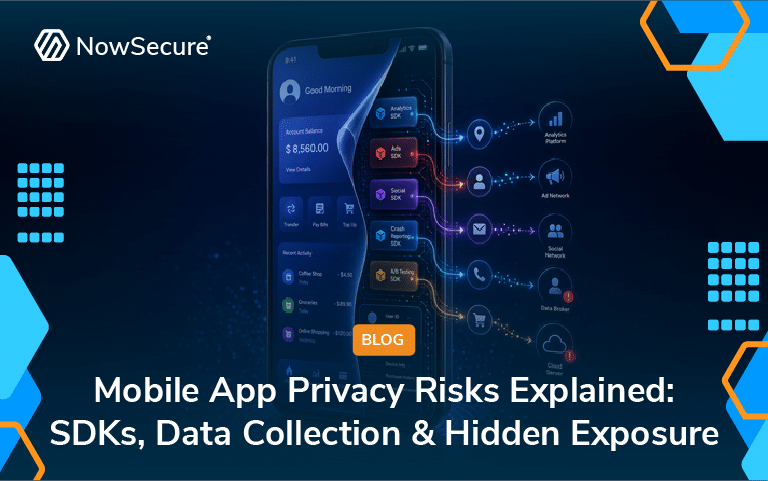
The infographic below breaks down the five most commonly overlooked mobile app privacy risks impacting enterprises today — and why existing security programs often miss them.
Mobile Apps Create a Security Visibility Gap Traditional Tools Can’t Close
Mobile apps don’t behave like web applications. They run on devices the organization doesn’t control, bundle third-party code that security teams rarely inspect and transmit data through channels that standard security testing wasn’t built to monitor. Unlike web apps where servers and traffic are largely within enterprise visibility, mobile apps run as compiled binaries on end-user devices — packaging code, SDKs and business logic in ways that perimeter and web-focused tools were never designed to reach.
The consequence is measurable. NowSecure research found that authenticated mobile app security testing detects 78% more sensitive data exposure per scan than unauthenticated testing — meaning the majority of actual exposure goes undetected in most assessments. Sensitive data can leak through insecure local storage, runtime behavior, device permissions or encrypted network traffic, none of which standard AppSec tools inspect.
In financial services, healthcare, retail and digital commerce, a single vulnerable SDK or undisclosed data flow can trigger regulatory penalties, customer trust damage and operational disruption faster than most incident response programs can respond.
Why Do Existing Security Controls Miss Mobile Privacy Risk?
Most enterprise security programs weren’t built with mobile in mind. The gap shows up on both sides of the development equation.
For teams building mobile apps, the problem starts in development. Developers routinely integrate third-party SDKs to add analytics, advertising, authentication or crash reporting functionality without fully understanding what those components collect or where that data goes. AI-generated and vibe-coded mobile apps compound the issue. Code produced at speed by developers without deep mobile security expertise routinely introduces privacy flaws that neither the developer nor the security team catches before release. Vibe coding exacerbates the risk.
For teams managing apps the organization deploys, MDM and UEM platforms enforce device-level policy but don’t inspect actual app behavior — what code executes, what servers an app connects to or what data it transmits. App store privacy labels are self-reported and frequently incomplete.
Across both scenarios the blind spot is the same: existing tools read what apps claim to do, not what the compiled binary actually does. Whether the SDK was embedded by your own developer or came bundled in a third-party app, it executes on device with the same permissions the app holds — collecting data, connecting to external endpoints and introducing supply-chain exposure that no privacy label, code review or MDM policy will surface.
That gap carries direct regulatory consequences. GDPR, CCPA, HIPAA, PCI DSS and COPPA all require organizations to validate actual application behavior, not just privacy policy language. Regulators are enforcing that distinction: Google settled with the Texas AG for $1.375B and a separate CCPA case reached $1B, both tied to mobile data practices. Neither outcome was the result of a company that didn’t have a privacy policy.
The compiled binary doesn’t care what the vendor disclosed. It just runs.
Continuous Testing Closes the Gap
Effective mobile privacy risk programs address both the apps organizations build and the apps they deploy. For development teams, that means integrating automated privacy testing into the build pipeline so SDK risks, insecure data flows and AI-introduced flaws get caught before release.
For security teams managing deployed apps, it means binary-level analysis on real devices that reveals actual runtime behavior regardless of what the vendor disclosed.
NowSecure Privacy gives security teams and developers continuous visibility into what their apps actually do. NowSecure Mobile App Risk Intelligence (MARI) reveals what deployed apps actually do — hidden data flows, risky endpoints and undisclosed AI components that vendor disclosures never surface.”
Across both scenarios, automated mobile application security testing uncovers what static reviews and vendor disclosures miss, including:
- Sensitive data exposure through insecure local storage and unencrypted transmission
- Risky or undisclosed third-party SDKs
- Gaps between privacy disclosures and actual runtime behavior
- Insecure network communications and connections to high-risk endpoints
- Excessive device permissions and dangerous entitlements
- Compliance exposure against GDPR, CCPA, HIPAA and OWASP MASVS controls
Integrating testing into CI/CD pipelines means risk gets surfaced before apps ship. For organizations assessing where exposure is greatest, auditing embedded SDKs is typically where the most significant findings are concentrated — many developers don’t fully know what SDKs in their apps are collecting or where that data goes.
AI-Enabled Mobile Apps Are Expanding the Risk Surface
The threat is also evolving. Most mobile apps now use AI in some form, with a subset transmitting sensitive data unencrypted to third-party cloud-based AI services. AI components embedded in mobile apps can process sensitive device data, connect to remote model endpoints and expose information through prompt-based data leakage — risks that don’t appear in traditional security testing coverage. Security programs that don’t account for AI-enabled mobile apps are carrying blind spots that will only grow.
Frequently Asked Questions
Why are mobile app privacy risks difficult to detect with standard security tools?
Standard AppSec tools — SAST, DAST, web proxies and API scanners — are built to analyze source code, web traffic and server-side behavior. Mobile privacy risks live in compiled app binaries executing on end-user devices, in the runtime behavior of embedded third-party SDKs and in encrypted network traffic to external endpoints. These aren’t visible to web-focused tools. Detecting them requires binary-level static analysis, dynamic testing on real devices and network traffic inspection specific to mobile app behavior.
What are the most common mobile app privacy risks?
The most frequently identified mobile app privacy risks include insecure local data storage of sensitive identifiers and credentials, unauthorized or undisclosed data collection by third-party SDKs, excessive device permissions granting access to camera, microphone, location and contacts beyond what the app requires, insecure network communications transmitting sensitive data without encryption and missing or inaccurate privacy disclosures in app store listings. NowSecure analysis of more than 525,000 app assessments found these issues consistently across iOS and Android, including in apps from major enterprises and government agencies.
Why are third-party SDKs a mobile app privacy risk?
Third-party SDKs are pre-built code libraries integrated into mobile apps to add functionality such as analytics, advertising, authentication or crash reporting. Once embedded, an SDK executes within the app with the same device permissions the app holds. SDKs can collect device identifiers, location data, behavioral data and other sensitive information — often without the app developer’s full knowledge and without disclosure to users. NowSecure research found that 97% of iOS apps tested were missing required Privacy Manifests for their third-party SDKs, meaning the data collection behavior of those SDKs was undisclosed. See also how dangerous permissions and SDK dependencies create enterprise security exposure and potentially even physical danger.
What compliance regulations apply to mobile app privacy?
Mobile apps are subject to GDPR, CCPA, HIPAA, PCI DSS and COPPA depending on the data they handle and the markets they operate in. GDPR requires a lawful basis for data collection and processing transparency. CCPA grants consumers rights over personal data collected by apps. HIPAA applies to apps handling protected health information. COPPA governs apps directed at children under 13. All of these frameworks require organizations to validate what their applications actually do at runtime — not just what privacy policies state. Non-compliance exposure from mobile apps has resulted in enforcement actions reaching into the billions.
Where should organizations start with mobile app privacy risk management?
The starting point is visibility into what your apps actually do — both the apps your teams build and the apps your organization uses. For development and security teams responsible for first-party apps, binary-level automated testing against OWASP MASVS privacy controls provides an objective baseline and catches SDK risks, data leakage and AI-introduced flaws before release. NowSecure Privacy is built for exactly that use case.
Ready to find out what your mobile apps are really doing? Get a free NowSecure Privacy assessment.